Back to 2026 Abstracts
ROBOT ASSISTED SURGICAL REPAIR OF NUTCRACKER SYNDROME: A CASE SERIES
Mahan Najhawan, MD1, Deeba Zadeh, BS2, Amy Rao, MD3, Chakaris Neal, MD3, Godfrey Parkerson, MD3, Michael Maddox, MD3.
1UMass Chan/Ochsner Clinic Foundation, Worcester, MA, USA, 2University of Queensland - Ochsner Clinical School, New Orleans, LA, USA, 3Ochsner Clinic Foundation, New Orleans, LA, USA.
Introduction: Nutcracker syndrome (NCS) is a rare cause of persistent left flank pain, hematuria and proteinuria that occurs due to compression of the left renal vein (LRV) between the superior mesenteric artery and the aorta. The current gold standard of definitive surgical treatment is an open abdominal left renal vein transposition (LRVT). There is a paucity of literature regarding utilizing robotic surgery for NCS repairs. Herein we present a case series of patients that underwent robotic repair for NCS at a single institution conducted by a single surgeon.
Methods: A retrospective review was conducted for all patients that had undergone robot assisted surgical repair for NCS between November 2022 and June 2025 at our institution. Key extracted data included patient demographics, diagnostic and operative data, and peri-operative and post-operative complications.
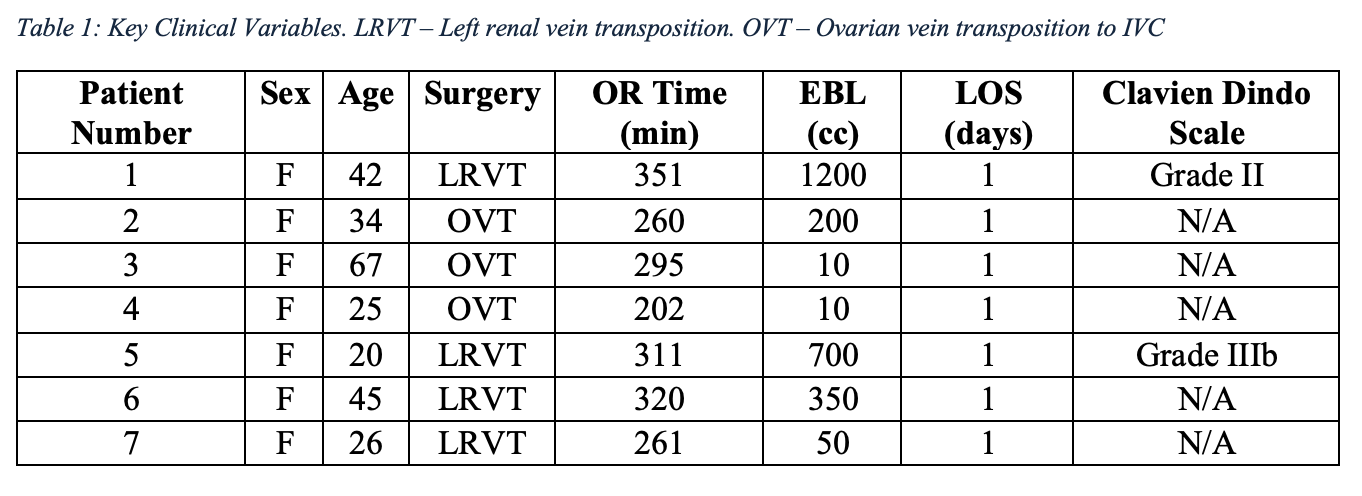
Results: A total of seven patients were identified, all female with a mean age of 37. NCS was initially diagnosed with a CT abdomen pelvis and confirmed with a venogram and intravascular ultrasound (IVUS). Four patients underwent repair with a robotic LRVT, and three patients with a robotic ovarian vein transposition (OVT). All seven patients were discharged post operative day 1 and had complete resolution of symptoms within 6 weeks. None of the patients had major complications. One patient (14%) required a blood transfusion intraoperatively. One patient (14%) required reoperation 7 months post-operatively due to return of symptoms.
Conclusion: Robotic LRVT and OVT could serve as an alternative to open or endovascular repair for NCS, offering a minimally invasive approach which is safe and effective, and could lead to lower hospital length of stay, quicker recovery, and reduced long term complications.
Back to 2026 Abstracts


