Back to 2026 Abstracts
Correlation Between MRI and Pathologic Measurements of the Prostate Resection Zone
Priscilla A. McElhinney, MS1, Patrick J. Soonthornprapuet, BS2, Wyatt LePenske, MS2, Kimberly A. Maciolek, MD3, Lori B. Lerner, MD2.
1Boston University School of Medicine, Boston, MA, USA, 2VA Boston Healthcare System, West Roxbury, MA, USA, 3University of Virginia, Charlottesville, VA, USA.
BACKGROUND: AUA Benign Prostate Hyperplasia (BPH) Guidelines recommend assessing prostate size and morphology prior to procedural intervention. MRI enables visualization of the prostatic resection zone (RZ), defined as tissue within the surgical capsule encompassing the central and transition zones, which may inform BPH procedural planning. We assessed agreement between RZ width measured on MRI, and pathology specimens from patients who underwent radical prostatectomy.
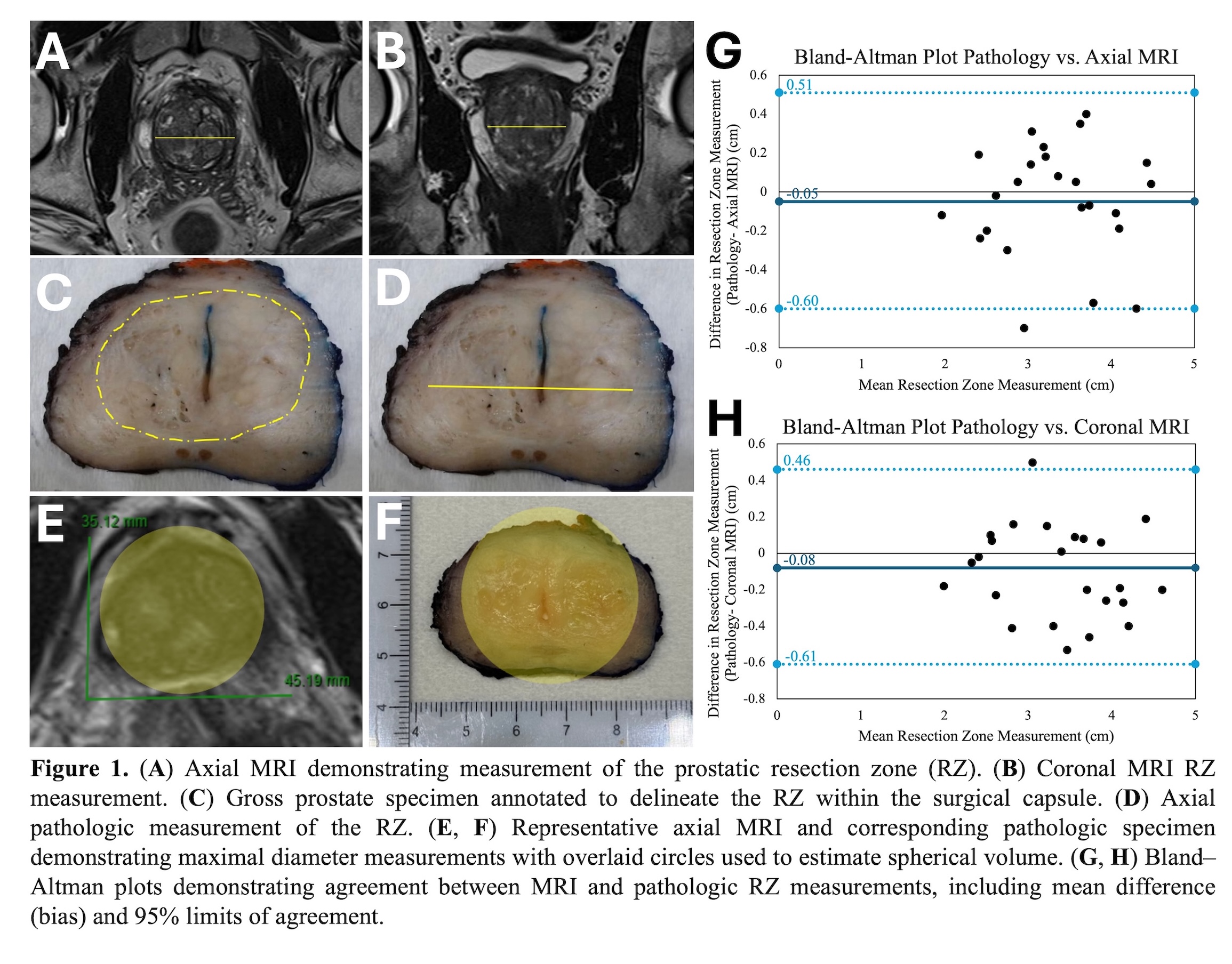
METHODS: We identified 25 males in the Veterans Affairs Boston Healthcare System who underwent radical prostatectomy between 07/2023-03/2026. MRI RZ width was measured at the widest point in axial and coronal planes, and pathologic RZ diameter was measured at the widest axial dimension (Fig. 1A-D). Spherical prostate volumes were calculated for each modality due to single-dimension pathology measurements (Fig. 1E, F). Agreement was assessed using descriptive and correlation analyses.
RESULTS: The mean RZ histologic diameter was 3.31±0.14cm. Mean MRI RZ diameters were 3.35±0.14cm (axial) and 3.38±0.15cm (coronal). The mean percent difference between MRI and pathology was 6.7±1.1% (axial) and 6.9±1.0% (coronal). MRI measurements demonstrated strong correlation with pathology (0.92, p<0.001 for axial and 0.93, p<0.001 for coronal). Bland-Altman analysis showed mean differences of -0.05cm (95% limits of agreement [LoA]: -0.60 to 0.51cm) for axial and -0.08cm (95% LoA: -0.61 to 0.46cm) for coronal measurements (Fig. 1G, H). Spherical volume calculations demonstrated strong correlation between MRI and pathology (0.90, p<0.001).
CONCLUSIONS:MRI-derived RZ measurements demonstrate strong agreement with pathologic measurements. These findings suggest MRI can reliably characterize RZ morphology and volume, which may help guide preoperative planning for BPH interventions.
Back to 2026 Abstracts


