Back to 2026 Abstracts
Transcriptomic analysis reveals distinct molecular pathways in lichen sclerosus-related urethral stricture disease
Amy Zheng, MD1, Lingge Yu, MS2, Jennifer Beane-Ebel, PhD2, Eric Burks, MD3, Travis Sullivan, MS1, Kimberly Rieger-Christ, PhD1, Alex Vanni, MD1.
1Lahey Hospital & Medical Center, Burlington, MA, USA, 2Boston University Chobanian and Avedisian School of Medicine, Boston, MA, USA, 3Boston Medical Center, Boston, MA, USA.
BACKGROUND: Lichen sclerosus (LS) is associated with more complex urethral stricture disease (USD) and higher recurrence rates following urethroplasty. However, molecular mechanisms driving LS-associated epithelial remodeling remain unclear. This study aims to identify differential gene expression in USD patients with and without LS.
METHODS: Urethral tissue was collected from LS and non-LS patients at the time of USD surgery and profiled by mRNA sequencing. High-quality mRNA-seq was obtained from 76 patients (n=33 LS, n=28 idiopathic, and n=15 traumatic USD). A subset of tissues was also profiled by microRNA PCR (n=21) to evaluate for associations with LS-related genes. LS-associated genes and miRNAs were identified using linear modeling. Pathways and cell types were identified using GSVA. Potential regulatory relationships were identified based on significant miRNA-gene expression anti-correlation and if the gene was a known target.
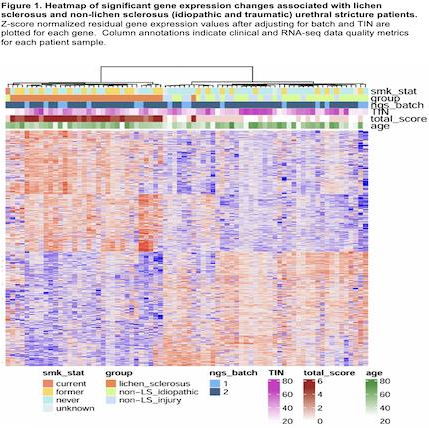
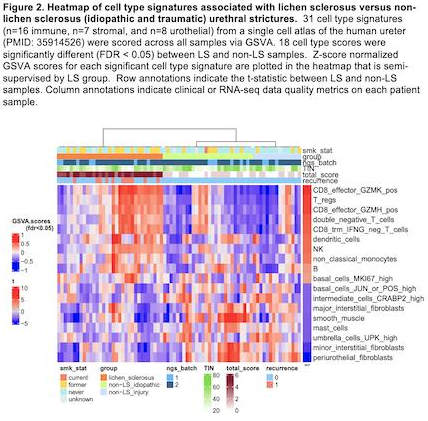
RESULTS: Analysis revealed 1322 genes to be differentially expressed at FDR<0.01 (677 upregulated and 645 downregulated) in LS versus non-LS USD (Figure 1). LS patients exhibited significant downregulation of estrogen and steroid pathways and upregulation of inflammatory pathways. miRNAs differentially expressed between LS and non-LS USD (n=33, FDR<0.15) were potential gene regulators associated with these signaling pathways. Genes implicated in epithelial and mesenchymal tissue remodeling were also differentially expressed in LS versus non-LS patients (Figure 2).
CONCLUSIONS: Distinct gene expression differences were identified in LS versus non-LS USD patients and were largely implicated in immune, hormonal and fibrotic processes. Further insights could lead to biomarker or therapeutic targets for future LS diagnosis, treatment and prevention.
Back to 2026 Abstracts


