Back to 2026 Abstracts
Incidence and Management of Post-Cystectomy Pelvic Organ Prolapse Among a Contemporary, Multi-Institutional Cohort
John Ernandez, MD, Vanessa Lukas, MD, Yu Zheng, MD.
Department of Urology, Brigham and Women's Hospital, Boston, MA, USA.
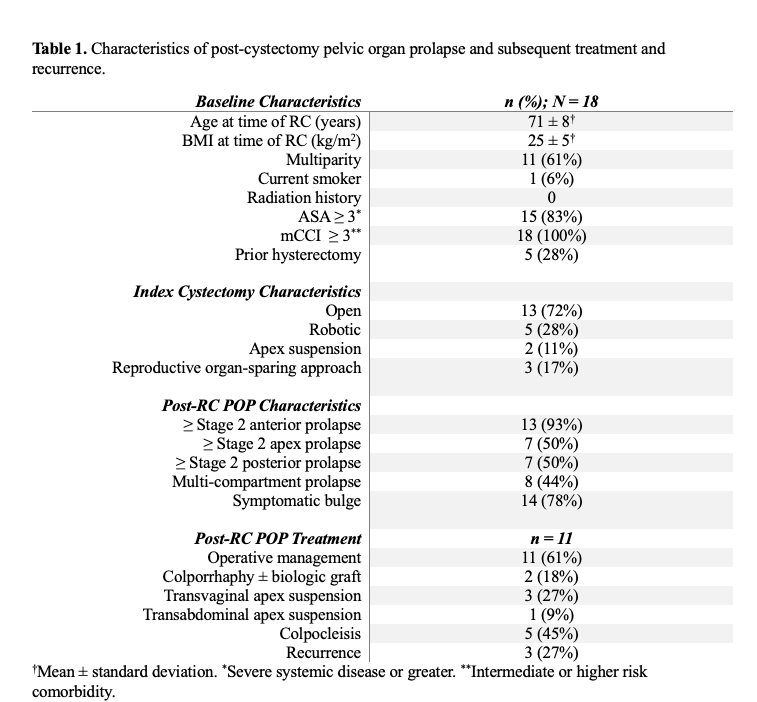
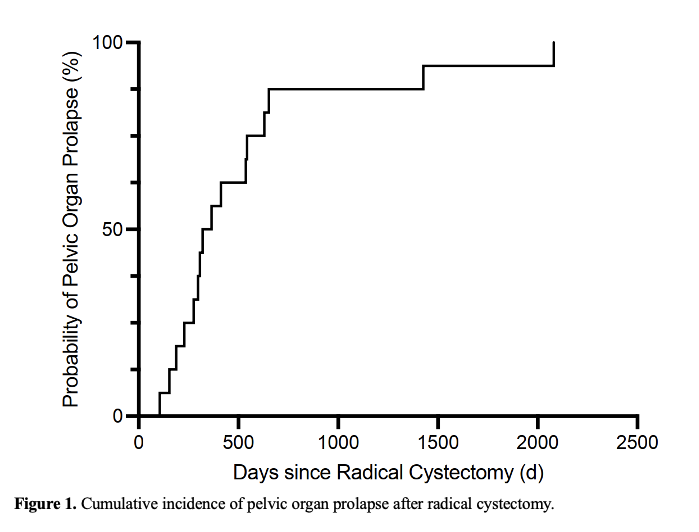
Background: Loss of ligamentous support at time of radical cystectomy (RC) may predispose women to pelvic organ prolapse (POP). Despite advances in cancer survivorship for women undergoing RC, women are infrequently counseled on post-RC POP, partly due to paucity of available data. We describe incidence and management of post-RC POP among our contemporary cohort. Methods: We identified 76 women with diagnoses of both POP and cystectomy among our institution. 58 were excluded due to missing data. Baseline characteristics were recorded (Table 1), including apex suspension and/or reproductive organ-sparing at time of RC. Time to post-RC POP and subsequent treatment were assessed. Results: 18 women with post-RC POP were identified, all undergoing incontinent diversion via ileal conduit. 61% were multiparous and 28% previously underwent hysterectomy. Apex suspension (11%) and reproductive organ-sparing (17%) at time of RC were uncommon. POP occurred by a median of 10 months from RC (Figure 1), with 78% presenting with symptomatic bulge and 93% with anterior prolapse. 61% sought operative repair with all except one undergoing a transvaginal approach. Operative repair occurred by a median of 15.8 months from RC. 27% required >1 revision for recurrence by a median of 12.2 months from index repair. Conclusions: Among a contemporary cohort of women undergoing RC, POP is both common and symptomatic. Women commonly developed prolapse within a year of their cystectomy. Our work highlights the importance of early involvement of urogynecologists in counseling patients regarding risk of POP and available options that align with their anatomy and goals.
Back to 2026 Abstracts


