Back to 2026 Abstracts
Inside the 2026 Urology Match: Program Director Insights on Selection and Ranking
Esther Chung, BS1, Katherine Wu, DO, MA2, Kathleen Kobashi, MD, MBA, FACS3, Marianne Casilla-Lennon, MD4.
1Frank H Netter SOM at Quinnipiac University, North Haven, CT, USA, 2McLaren Macomb Hospital Department of Urology, Mt Clemens, MI, USA, 3Houston Methodist Hospital Department of Urology, Houston, TX, USA, 4Yale University Department of Urology, New Haven, CT, USA.
BACKGROUND: The urology residency match has seen significant changes, including pass/fail USMLE Step 1, preference signaling, and evolving interview formats. Although holistic review is widely endorsed, the relative weight of selection factors remains elusive and may inadvertently reinforce disparities for applicants without established urology infrastructure. This study characterizes the most up-to-date factors that program directors (PDs) use to describe the ideal urology applicant, highlighting positive and negative factors that drive interview and ranking decisions.
METHODS: A comprehensive survey, developed with input from an expert Society of Academic Urologists (SAU) member panel, was distributed to ACGME-accredited SAU member institutions following the 2026 urology match. PDs ranked factors by importance and identified those that decreased competitiveness. Descriptive statistics and thematic analyses summarized responses.
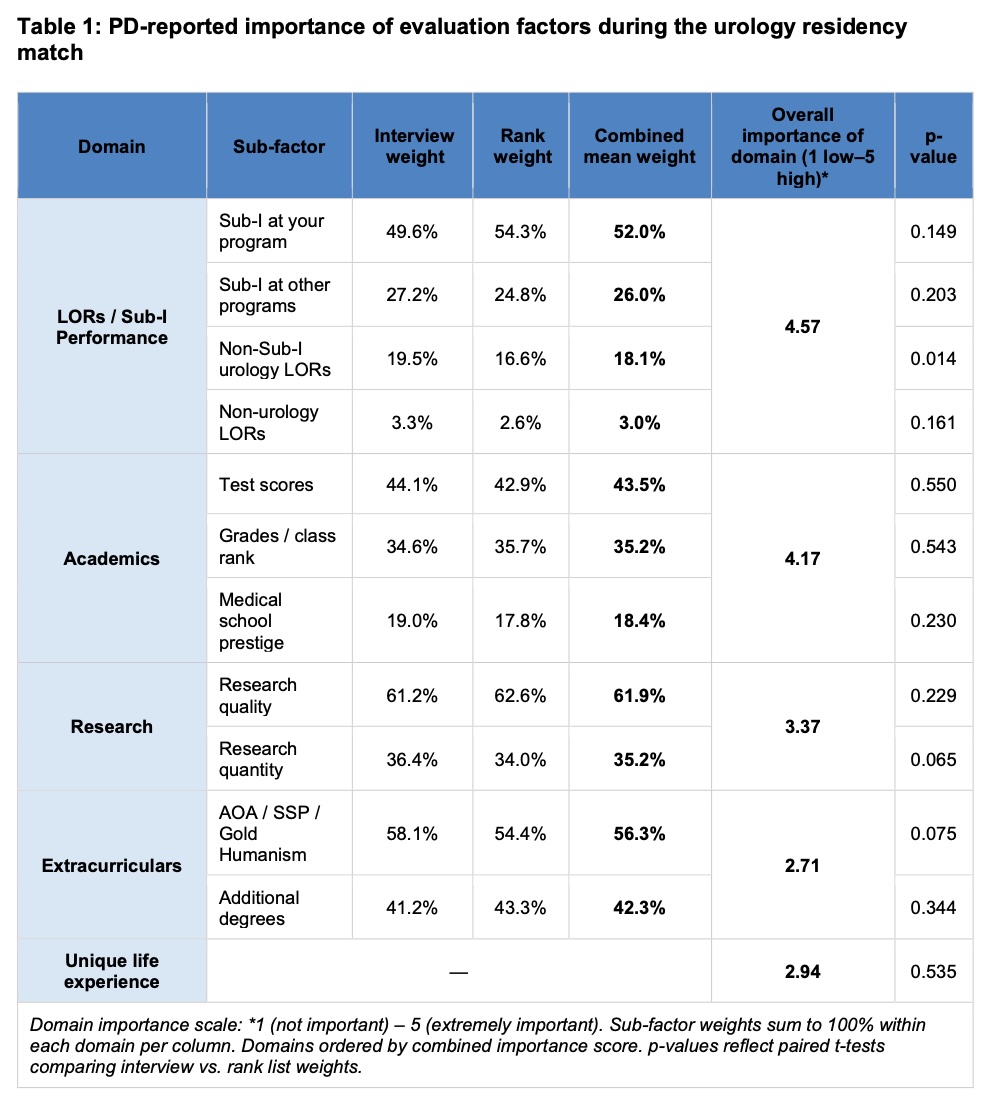
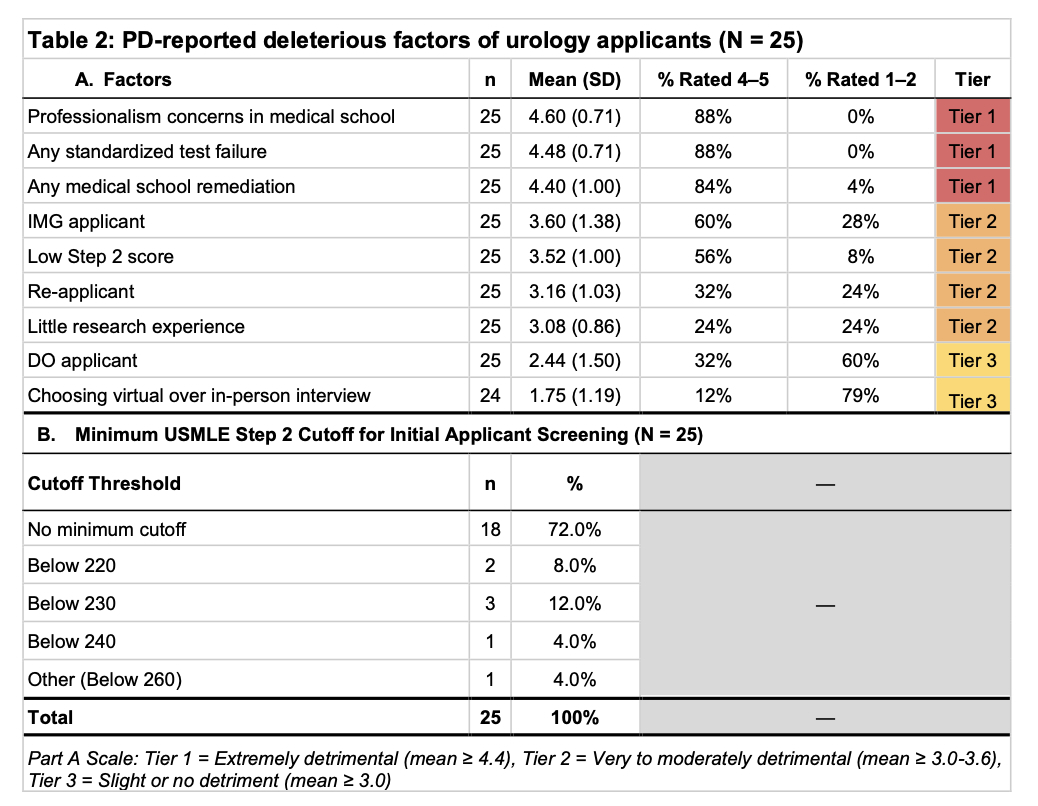
RESULTS: Fifty PDs responded to at least one question, representing all AUA regions and program sizes. The most heavily weighted factors were home sub-internship (sub-I) performance (52%), outside sub-I performance (26%), and letters of recommendation (LOR, 18%, Table 1). Professionalism concerns and board exam failures were extremely detrimental, whereas low Step 2 scores, IMG or re-applicant status, and limited research were moderately detrimental (Table 2). Most programs reported no minimum Step 2 cutoff, though those who did cited below 230.
CONCLUSIONS:Post-COVID changes, the urology match prioritizes direct clinical performance and trusted recommendations over traditional academic metrics. Yet the most heavily weighted factors, Sub-I access and urology network, are not equally accessible for applicants. Greater transparency on selection criteria can guide applicants and support equitable recruitment.
Back to 2026 Abstracts


