Back to 2026 Abstracts
High-Risk Decipher Score Independently Predicts Recurrence After Primary Focal Therapy Within a Localized Prostate Cancer Cohort
Anthony Zhang, BS, Nethusan Sivanesan, BS, Andrea Lopez-Sanmiguel, MD, Preston C. Sprenkle, MD.
Yale University School of Medicine, New Haven, CT, USA.
Introduction: Decipher genomic classifier score (GC) is validated for postoperative risk stratification but remains underexplored in focal therapy (FT)
1. We evaluated whether pre-treatment Decipher category predicts clinically significant prostate cancer recurrence following primary FT across multiple ablation modalities.
Methods: We retrospectively reviewed men undergoing primary subtotal FT (cryoablation, transurethral ultrasound ablation [TULSA], or irreversible electroporation [IRE]) from 2014-2025 with available pre-treatment Decipher test. Subtotal FT was defined as ≤50% prostate ablation. The primary endpoint was clinically significant prostate cancer recurrence (csPCa; Grade Group (GG) ≥2) on biopsy at 12 months (6-18) or 24 months (19-30) biopsies. Decipher categories (low<0.45, intermediate 0.45-0.60, high risk ≥0.60) were compared with Fisher's exact and multivariable logistic regression adjusting for age, PSA density, Gleason grade, and treatment modality.
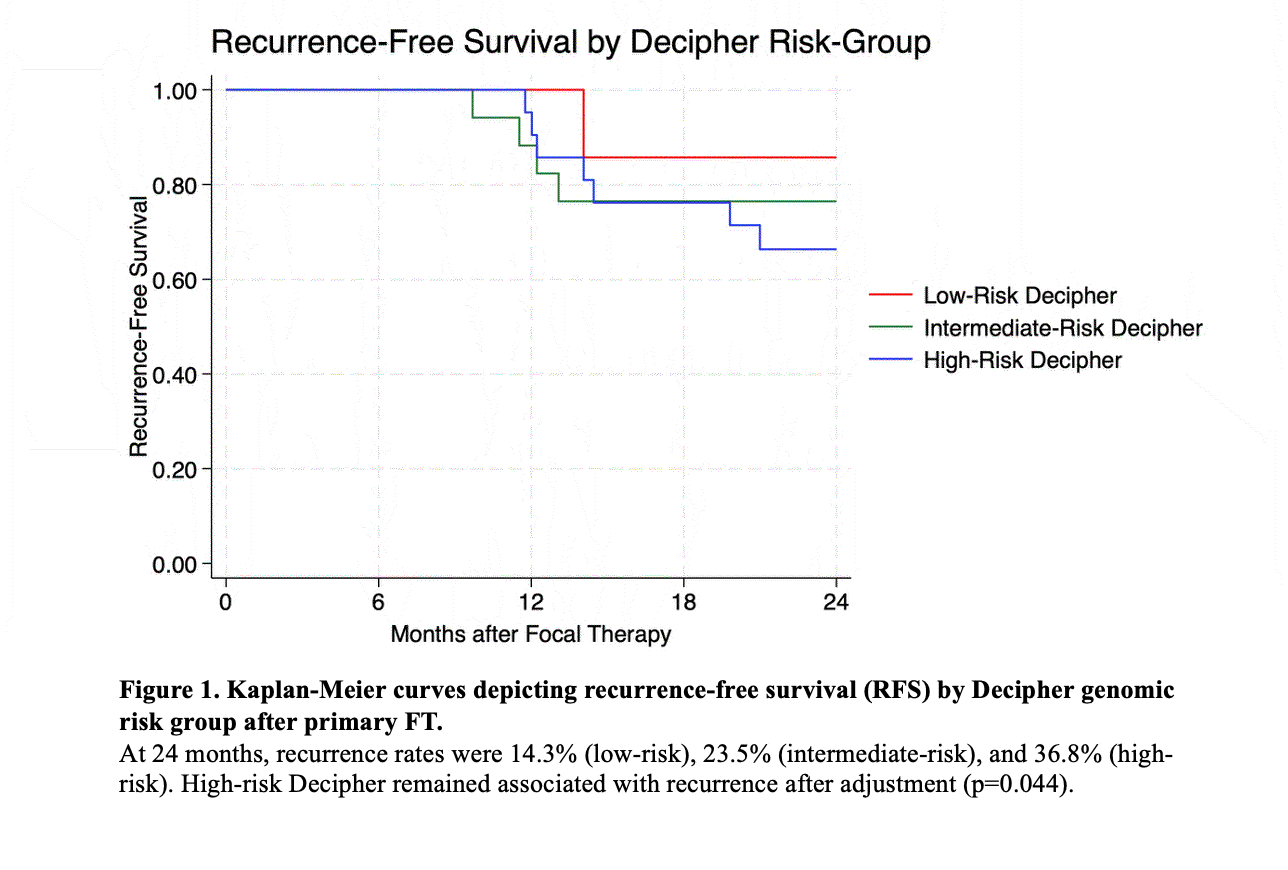
Results: Among 76 patients, 44 (58%) underwent 12-month and 14 (21%) underwent 24-month biopsy. Recurrence occurred in 17 (37.8%). Recurrence rates increased with genomic risk at 12 months (p=0.164) and 24 months (14.3%, 23.5%, 36.8%) across low-risk, intermediate-risk, and high-risk, respectively (p=0.097). High-risk Decipher was associated with greater recurrence compared to low- and intermediate risk groups (p=0.019). On multivariable analysis, high-risk Decipher remained independently associated with recurrence (p=0.044) while intermediate-risk did not. Associations were consistent across modalities (p=0.81).
Conclusions: Within this cohort, high-risk Decipher score independently predicted recurrence following primary FT, beyond clinical variables. These findings suggest benefit of Decipher in identifying patients more likely to fail FT, with consideration for counseling and closer post-treatment surveillance.
Back to 2026 Abstracts


