Back to 2026 Abstracts
Does Deprivation Equal Complications? How Socioeconomic Status Predicts Radical Cystectomy Outcomes
Adam Jeffrey Cole, MD1, Emilie Platteter, BS2, Randie White, MD3, Danniel Lassman, BA4, Michael Morandini, BS4, Aniket Hingnekar, BS5, Stephen Ryan, MD1, Matthew Hayn, MD1, Jesse Sammon, DO1, Vitaly Margulis, MD5, Jeffrey Howard, MD, PhD1.
1Maine Medical Center, Portland, ME, USA, 2University of New England, Portland, ME, USA, 3Vanderbilt, Nashville, TN, USA, 4Tufts University, Boston, MA, USA, 5University of Texas Southwestern Medical Center, Dallas, TX, USA.
BACKGROUND: Radical cystectomy (RC) is a complex operation with high rates of postoperative complications and readmissions. The Area of Deprivation Index (ADI) is a census-based measure of socioeconomic disadvantage. We evaluated whether ADI predicts major complications and 90-day readmissions after RC.
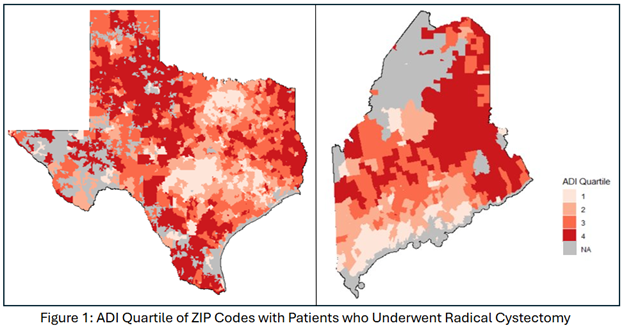
METHODS: We conducted a retrospective review of 352 patients who underwent RC between 2015 and 2025 at a single institution. An external validation cohort included 551 patients treated between 2016 and 2020 at a separate institution. Postoperative complications were graded using the Clavien-Dindo classification system. ADI data were assigned based on residential zip codes. Multivariable logistic regression models assessed associations between outcomes (major complications and 90-day readmissions) and ADI quartiles, surgical approach, and patient characteristics. Analyses were repeated in the validation cohort.
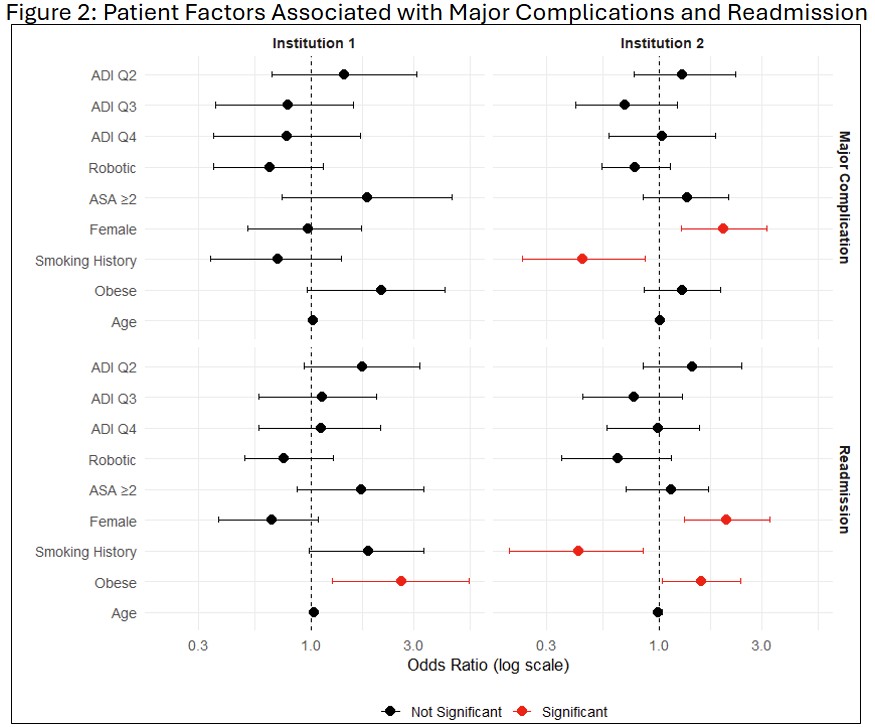
RESULTS: ADI quartile was not associated with major complications or 90-day readmissions at either institution. Obesity was a significant predictor of readmission in both cohorts (OR 2.64, p=0.01; OR 2.06, p=0.02). At the second institution, female sex was associated with higher odds of major complications and readmission (OR 2.0, p=0.002; OR 2.06, p=0.02). Unexpectedly, any history of smoking was associated with lower odds of both outcomes (OR 0.44, p=0.016; OR 0.42, p=0.021).
CONCLUSIONS: ADI was not associated with complications or readmissions following RC. These findings suggest that population-level socioeconomic measures may have limited predictive value at the institutional level, where patient- and care-specific factors likely play a larger role in outcomes.
Back to 2026 Abstracts


