Back to 2026 Abstracts
Dose-Response Relationship Between Food Insecurity Severity and Lower Urinary Tract Symptom Subtypes: A Nationally Representative Cross-Sectional Study
Aaron M. Seto, BA1, Andrew Yang, BS1, Michael Sheen, BS1, Jack Mulcrone, BS1, Taemin Kim, BS1, Meredith Wasserman, MD, MS2.
1Warren Alpert Medical School of Brown University, Providence, RI, USA, 2Department of Urology, Brown University Health, Providence, RI, USA.
BACKGROUND: Food insecurity affects ~14% of U.S. households and has been hypothesized to contribute to lower urinary tract symptoms (LUTS) through chronic psychological stress and reliance on processed foods containing bladder irritants. No nationally representative study has examined whether food insecurity severity is associated with greater LUTS burden across specific subtypes in a dose-response manner. We examined whether USDA food security classification demonstrates a dose-response relationship with nocturia, urge UI (UUI), stress UI (SUI), and mixed UI (MUI).
METHODS: Pooled data from 7 NHANES cycles (2005-2020) yielded 36,713 adults aged ≥20 years categorized by food security: full, marginal, low, or very low. Outcomes: nocturia (≥2 voids/night), UUI, SUI, and MUI. Survey-weighted logistic regression used four sequential models adjusting for demographics (Model 1), income-to-poverty ratio and survey cycle (Model 2), BMI, diabetes, hypertension, and CKD (Model 3), and depression PHQ-9≥10 (Model 4). Trends assessed via Wald test (114 strata, 233 PSUs).
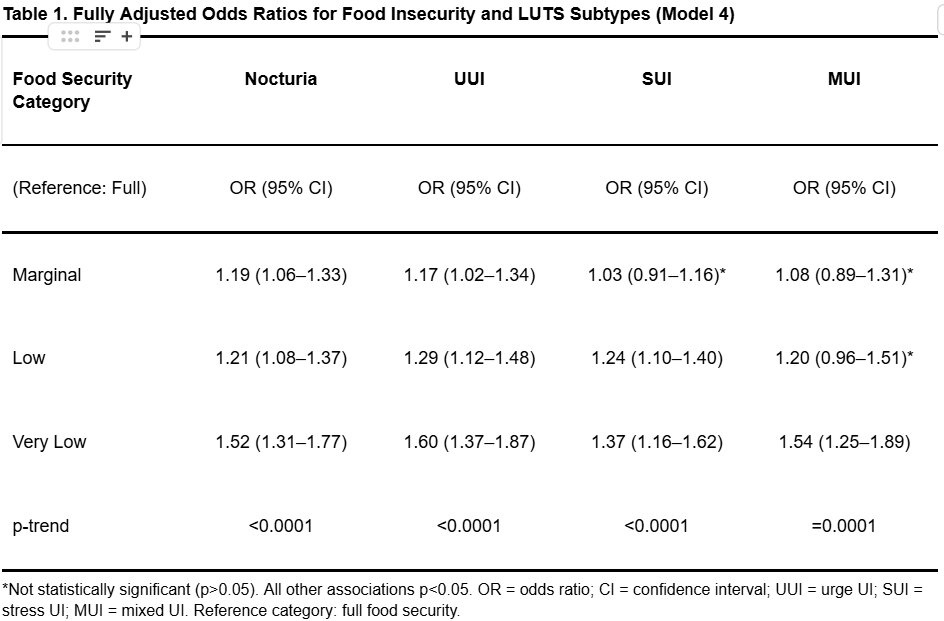
RESULTS: The weighted sample (mean age 47.7 years, 51.3% female) represented ~204 million U.S. adults. Food security distribution: 76.0% full, 9.2% marginal, 9.1% low, and 5.7% very low. LUTS prevalence: 26.4% nocturia, 24.0% SUI, 20.4% UUI, and 7.9% MUI. Results shown in Table 1. Dose-response trends confirmed across all subtypes (nocturia, UUI, SUI: p-trend <0.0001; MUI: p-trend =0.0001). Nocturia and UUI demonstrated steeper gradients than SUI. Associations persisted after PIR adjustment.
CONCLUSIONS:Food insecurity is dose-responsively associated with all LUTS subtypes, exhibiting steepest gradients for nocturia and UUI and a threshold pattern for MUI. Associations persisted after income adjustment, suggesting food insecurity captures health-relevant hardship beyond poverty alone. These findings support food security screening in urological settings and highlight food access as a potential modifiable intervention.
Back to 2026 Abstracts


