Back to 2026 Abstracts
Using Urine Tumor DNA to De-Intensify Surveillance in Non-Muscle Invasive Bladder Cancer: Interim Analysis of a Prospective Randomized Trial
Samuel S. Iofel, BA1, Tai Nguyen, BS1, Namit D. Sambare, BS2, Travis B. Sullivan, MS3, Zhibang Lin, MS3, Tasneem Z. Rizvi, PhD3, Matthew B. Clements, MD, MS3.
1Tufts University School of Medicine, Boston, MA, USA, 2UMass Chan Medical School, Worcester, MA, USA, 3Lahey Hospital and Medical Center, Burlington, MA, USA.
Introduction: Non-muscle invasive bladder cancer (NMIBC) requires intensive surveillance with AUA guidelines recommending cystoscopy and urine cytology every 3-4 months for 2 years. Urinary cell-free DNA analysis of bladder cancer-attributed mutations (utDNA) is an emerging biomarker, associated with recurrence-free survival and response to treatment. Studies suggest greater sensitivity compared to cystoscopy and urine cytology.
Methods: We are conducting an investigator-initiated randomized trial enrolling high-risk NMIBC patients who responded to induction BCG or gemcitabine/docetaxel. Participants with a negative UroAmp MRD (utDNA) test are randomized to standard surveillance (cystoscopy/urine cytology q3 months) or a de-intensified protocol (cystoscopy/urine cytology q6 months with prior UroAmp testing, until recurrence or positive utDNA). An interim analysis at 1 year was conducted; data will be updated at the time of presentation. A univariate analysis assessed factors associated with UroAmp positivity; Kaplan-Meier analysis evaluated the rate of conversion to a positive test in the de-intensified arm.
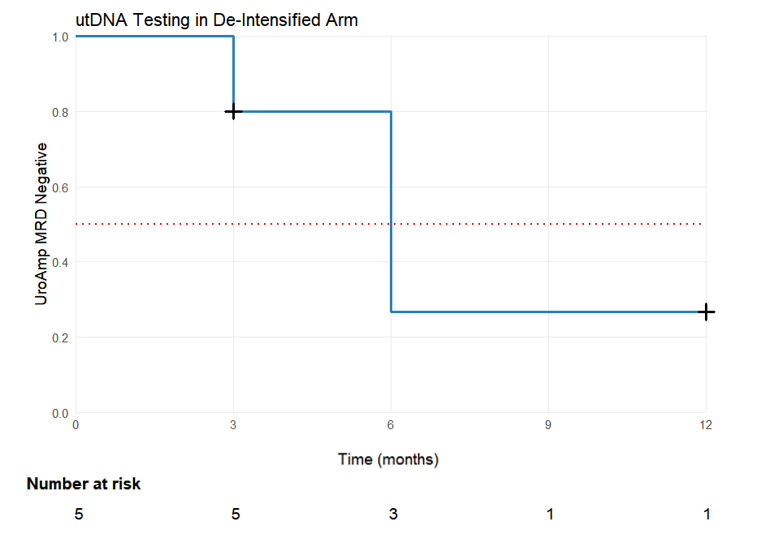
Results: Since 1/2025, 21 participants enrolled. 6 (29%) were UroAmp positive post-induction. Of the remaining 15, 10 were randomized (5 declined/ineligible). Baseline characteristics were generally similar between patients with positive and negative UroAmp testing at screening. For instance, T1 disease was observed in 27% (negative) versus 33% (positive); mean tumor size was 3.7 (negative) versus 3.3 cm (positive) and both participants with CIS were UroAmp negative. Remarkably, there have been no clinical recurrences. Within the 5 participants in the de-intensified arm, the median time to UroAmp conversion to positive was 6 months (Figure).
Conclusions: A higher-than-expected percentage of patients were UroAmp positive at initial testing; however, no correlation with clinical recurrence was observed. Additional data are needed to quantify the association of UroAmp positivity with later recurrence.
Back to 2026 Abstracts


