Back to 2026 Abstracts
Standardizing the use of transperineal bulbar urethral ultrasonography to identify patients with pre-operative urethral fragility: Establishing normative data for a pilot study
Philip Olson, MD1, Ilene Staff, PhD2, Tara McLaughlin, PhD2, Joseph Tortora, MS2, Kevin Pinto, BS2, Richard Kershen, MD2.
1UConn Health, Farmington, CT, USA, 2Hartford Healthcare, Hartford, CT, USA.
BACKGROUND: Men with prior pelvic radiation face a higher complication rate following placement of an artificial urinary sphincter, however few tools exist to objectively assess pre-operative risk. Ultrasound has historically been effective in evaluating urethral strictures and erectile dysfunction. We hypothesized that transperineal bulbar urethral ultrasound (TBUU) could identify bulbar urethral fragility in men with prior pelvic radiation prior to anti-incontinence surgery. In preparation for a pilot study to pursue this question, we standardized the TBUU procedure in five control subjects and present the normative data here.
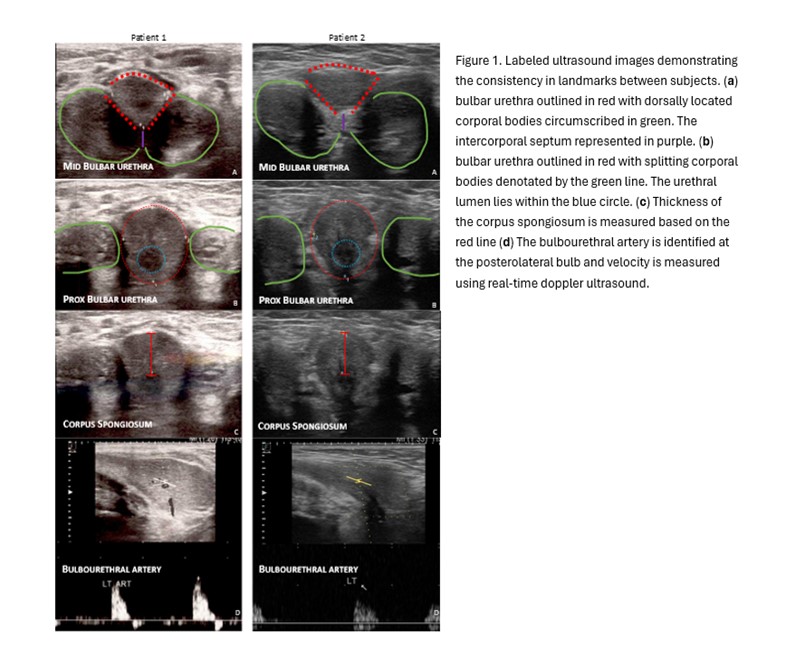
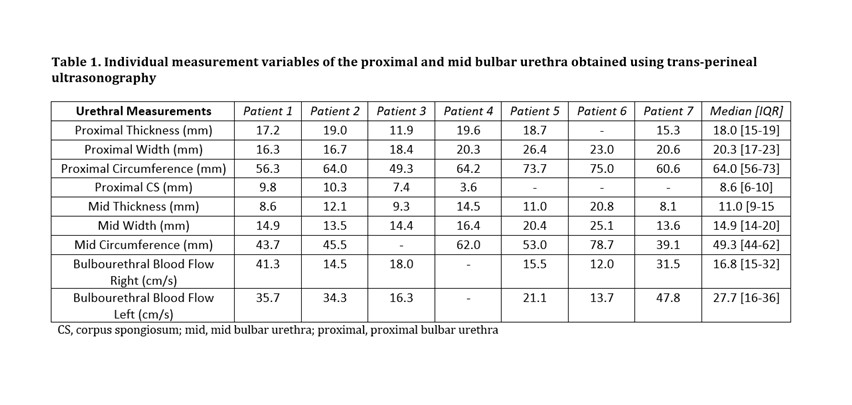
METHODS: Control subjects were men aged 18-89 undergoing prostate biopsy for suspected cancer. Using a Fujifilm Arietta 65 with high-frequency linear probe, TBUU was performed before biopsy. Patients were placed in lithotomy with the scrotum elevated to expose the perineum. Known anatomic landmarks were used to identify the mid and proximal bulbar urethra on ultrasound (Figure 1). Mid and proximal bulbar urethra were identified via sonography. Urethral thickness, width, circumference, and corpus spongiosum (CS) thickness were measured in the axial plane. Bulbourethral artery flow velocity was obtained using color-wave Doppler in the sagittal plane. A radiologist reviewed images for accuracy.
RESULTS: The five patients underwent successful TBUU without complications. CS thickness was inconsistently visualized and omitted in three (Table 1). Bulbourethral blood flow varied notably among patients.
CONCLUSIONS: TBUU may aid in identifying patients with urethral fragility in the pre-operative setting. Standardizing the TBUU procedure has laid the foundation for the now ongoing pilot study described above.
Back to 2026 Abstracts


