Back to 2026 Abstracts
Development and Validation of a Machine Learning Prediction Model for Inflatable Penile Prosthesis Intraoperative Complications to Improve Preoperative Counseling
Bailey Carter, M.D.1, David Han, MS2, Muhammed Hammad, MBBCh3, Martin Gross, MD1, Samuel Ivan, MD4, Justin Schneider, BA3, Jonathan Prunean, .3, Elia Elia Abou Chawareb, MD3, Babak Azad, MD5, Daniel Swerdloff, MD6, Jake Miller, MD3, Robert Andrianne, MD, PhD7, Arthur Burnett, MD8, Kelli Gross, MD9, Georgios Hatzichristodoulou, MD10, James Hotaling, MD, MS9, Tung-Chin Hsieh, MD11, Aaron Lentz, MD12, Daniar Osmonov, MD13, Sung Hun Park, MD14, Ian Pearce, BMBS15, Paul Perito, MD16, Hossein Sadeghi-Nejad, MD17, Faysal Yafi, MD3, Jay Simhan, MD4.
1Dartmouth Hitchcock Medical Center, Lebanon, NH, USA, 2The Dartmouth Institute for Health Policy and Clinical Practice, Geisel School of Medicine at Dartmouth College, Lebanon, NH, USA, 3University of California, Irvine, Irvine, CA, USA, 4Fox Chase Cancer Center, Temple Health, Philadelphia, PA, USA, 5Tulane University School of Medicine, New Orleans, LA, USA, 6Northwell Health, Brooklyn, NY, USA, 7University Hospital of Liège, Liège, Belgium, 8Johns Hopkins School of Medicine, Lutherville, MD, USA, 9University of Utah, Salt Lake City, UT, USA, 10Martha-Maria Hospital Nuremberg, Nuremberg, Germany, 11University of California, San Diego, San Diego, CA, USA, 12Duke Health, Raleigh, NC, USA, 13University Hospital Schleswig-Holstein, Lübeck, Germany, 14Sewum Prosthetic Urology, Seoul, Korea, Republic of, 15Manchester University NHS Foundation Trust, Manchester, United Kingdom, 16Perito Urology, Coral Gables, FL, USA, 17New York University, New York, NY, USA.
BACKGROUND: Intraoperative complications during inflatable penile prosthesis (IPP) surgery are uncommon in experienced hands but can have devastating patient consequences. In the era of large databases, machine learning models analyze meaningful outcomes like intraoperative complications; the model may then recognize and apply data patterns (i.e., features) to predict future outcomes with greater accuracy compared to traditional approaches. To promote preoperative counseling and planning, we developed and validated a machine learning-based screening tool to support structured risk stratification for intraoperative events.
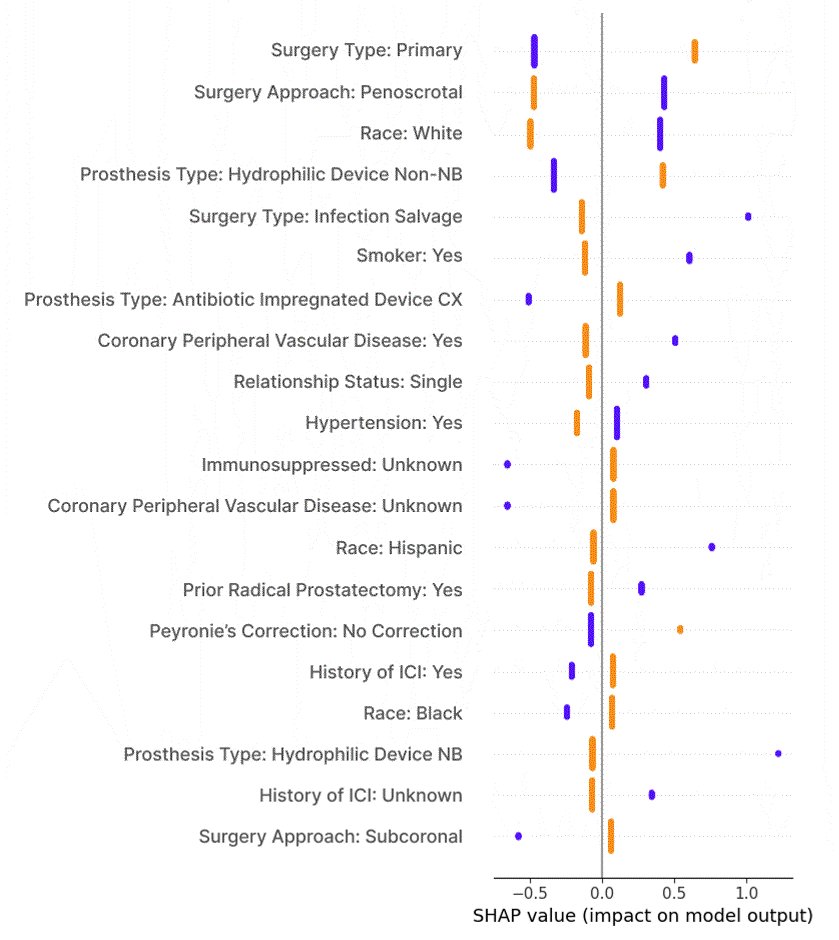
METHODS: Of 5,815 IPP surgical records, we identified 104 intraoperative complication cases (1.8%). Free-text entries were consolidated into a classification system (i.e., unified taxonomy) for intraoperative complications to include corporal perforation, crossover, and urethral injury. Model features included patient demographics, surgical approach, prosthesis type, intraoperative metrics, and intraoperative complications. The primary outcome was model performance (i.e., sensitivity) based on combinations of three parameters: 80%/20% train/test splits (n=2: standard and temporal), resampling (n=4: random undersampling, SMOTE, hybrid, and none), and classifiers (n=10: logistic regression, random forest, gradient boosting, histogram GB, Bernoulli NB, SVC, MLP, XGBoost, LightGBM, and CatBoost). Based on the model configuration with the greatest performance, we assessed which features signified a higher probability of intraoperative complications. Feature impact was analyzed via Shapley Additive exPlanations (SHAP).
RESULTS: In the standard split model, random undersampling with logistic regression offered the highest performance (sensitivity 74%). SHAP analyses identified the penoscrotal approach (+0.43) and infection salvage surgery (+1.02) as the strongest contributors to intraoperative complication prediction propensity (Figure). Primary surgery type (-0.48) was associated with lower predicted risk of intraoperative complications.
CONCLUSIONS: An internally validated machine learning model within a unified complication taxonomy achieved 74% sensitivity for intraoperative IPP complication screening. Ongoing external validation will further optimize targeted risk mitigation strategies.
Source of Funding: SMSNA Scholars in Sexuality Research Grant
Back to 2026 Abstracts


