Back to 2026 Abstracts
Machine Learning Prediction of Non-Infectious Post-IPP Complications Utilizing a Large Multicenter Collaborative: Unified Taxonomy and Validation
Ambrose Orr, MD1, Martin Gross, MD1, Muhammed Hammad, MBBS, MSc2, S Ivan, MD3, Bailey Carter, MD1, Elia Chawareb, MD2, Nicholas Moll, MD1, Faysal Yafi, MD2, Thairo Pereira, MD4, Jacob Good, MD4, Helen Bernie, MD4, Aaron Lentz, MD5, Alfredo Suarez-Sarmiento, MD6, Paul Perito, MD6, David Barham, MD7, Mike Hseih, MD8, Jay Simhan, MD3.
1Dartmouth Hitchcock Medical Center, Lebanon, NH, USA, 2University of California Irvine, Dept of Urology, Orange, CA, USA, 3Fox Chase Cancer Center, Philadelphia, PA, USA, 4Indiana University, Indianapolis, IN, USA, 5Duke University, Durham, NC, USA, 6Perito Urology, Coral Gables, FL, USA, 7Brooke Army medical Center, Fort Sam, Houston, TX, USA, 8University of California San Diego, Dept of Urology, San Diego, CA, USA.
BACKGROUND: Inflatable penile prosthesis (IPP) surgery risk assessment lacks standardized tools. We developed and validated a machine learning-based screening tool using a unified complication taxonomy.
METHODS: We analyzed 5,815 multicenter surgical records, including primary, revision, and infection salvage cases. Free-text entries were consolidated into a taxonomy. Features (38 total) included demographics, comorbidities, surgical/prosthetic factors, and intraoperative variables. We identified 393/5,815 complication-positive cases (6.76% prevalence). We evaluated 80 model configurations using 80/20% train/test splits (standard and temporal), resampling methods (RUS, SMOTE, hybrid, none), and 10 classifiers from Scikit-learn and gradient boosting libraries. Performance metrics: macro-averaged precision, recall, F1, and PR-AUC (precision recall-area under the curve). Feature impact analyzed via SHAP (Shapley Additive Explanations) with global summary plots.
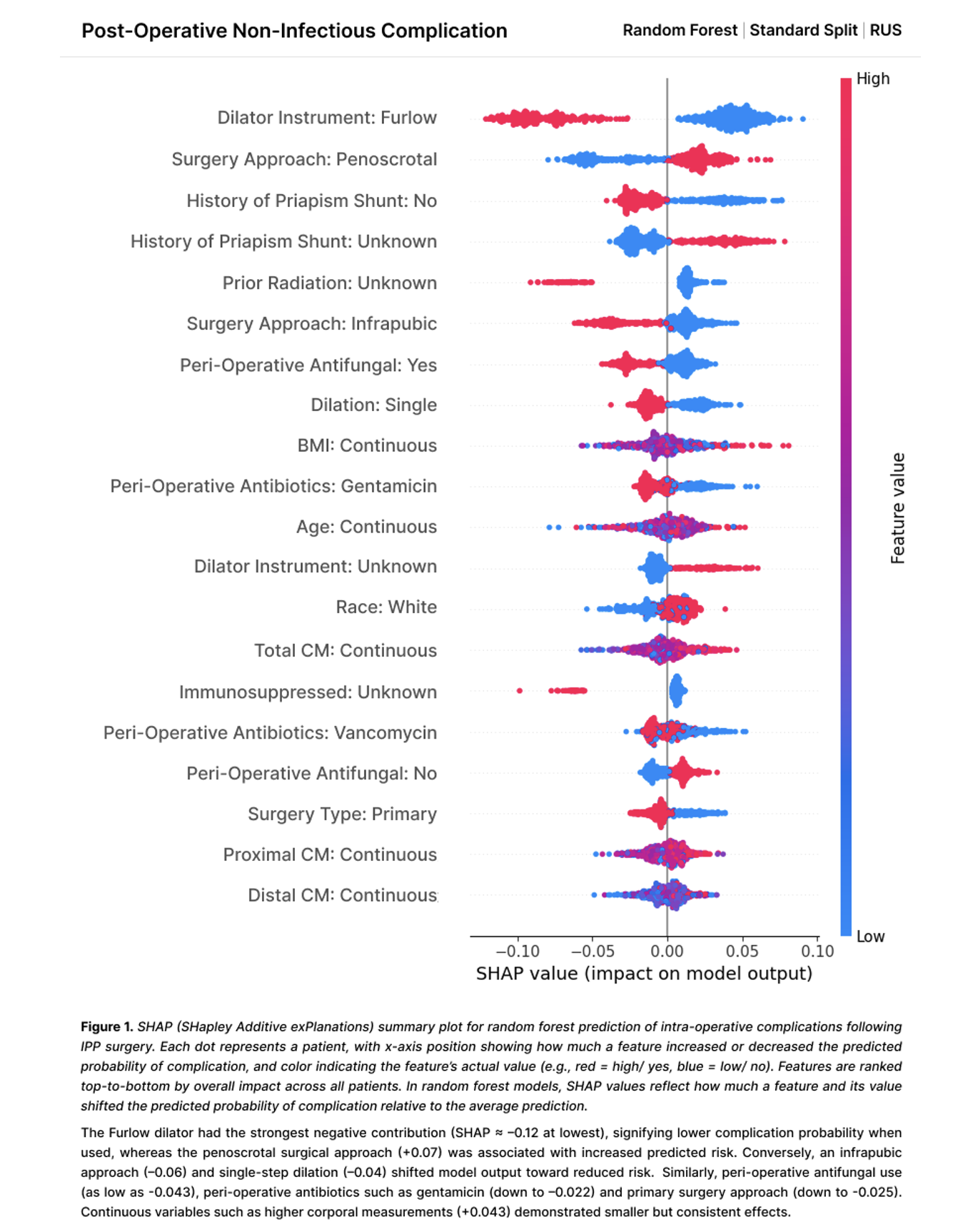
RESULTS: Random Forest with RUS yielded optimal performance in the standard split (Precision: 0.5781, Recall: 0.7861, F1: 0.5415, PR-AUC: 0.2365). SVC (support vector classifier) with RUS performed best in the temporal split (Precision: 0.5762, Recall: 0.8993, F1: 0.5763, PR-AUC: 0.2350). SHAP analysis revealed key predictors: single dilation with Furlow instrument and primary surgery type were associated with no-complication propensity; penoscrotal approach and infrapubic approach were associated with higher and lower complication propensity, respectively. Higher total corporal measurements (CM) were associated with an increased propensity for post-operative non-infectious complication prediction. (Fig 1)
CONCLUSIONS: A machine learning model utilizing both preoperative and intraoperative data within a unified complication taxonomy achieved 79% sensitivity for non-infectious postoperative complication screening after IPP surgery, highlighting its utility for pre-operative counseling. High recall affirms clinical value; external validation via a web platform is underway, with future work focused on prospective clinical integration to advance management of non-infectious complications.
Back to 2026 Abstracts


