Back to 2026 Abstracts
Deployed Inflatable Penile Prosthesis (IPP) Risk Calculator: A Machine Learning Platform for Multi-Center Validation of Three Predictive Models
Muhammed Hammad, MBBCh1, Martin Gross, MD2, Nicholas Moll, MD2, Samuel Ivan, MD3, Elia Chawareb, MD1, Yash Kadakia, MD1, Faysal Yafi, MD1, Thairo Pereira, MD4, Jacob Good, MD5, Helen Bernie, DO6, Nicklas Sarantos, MD7, Aaron Lentz, MD7, Alfredo Suarez-Sarmiento, Jr., MD8, Paul Perito, MD8, Joshua Schammel, MD9, Charles Welliver, MD9, Zayda Dominick, MD10, Ketch Cowan, MD10, Anand Shridharani, MD10, Brian Im, MD11, Paul Chung, MD11, Vi Nguyen, MD12, Michael Hsieh, MD12, Bryce Baird, MD13, Allen Morey, MD13.
1University of California, Irvine, Irvine, CA, USA, 2Dartmouth Hitchcock Medical Center, Lebanon, NH, USA, 3Fox Chase, Philadelphia, PA, USA, 4University of Rochester, Rochester, NY, USA, 5Indiana University, Indianapolis, IN, USA, 6Indiana University, Carmel, IN, USA, 7Duke University, Durham, NC, USA, 8Perito Urology, Coral Gables, FL, USA, 9Albany Medical College, Albany, NY, USA, 10Erlanger Health System, Chattanooga, TN, USA, 11Thomas Jefferson University, Philadelphia, PA, USA, 12UC San Diego, San Diego, CA, USA, 13Urology Clinics of North Texas, Dallas, TX, USA.
INTRODUCTION: We developed and deployed a web-based, real-time risk calculator for predicting intraoperative, postoperative non-infectious, and infectious complications following inflatable penile prosthesis (IPP) surgery. The platform enables transparent, multi-center validation and comparative endpoint assessment of machine-learning based risk models.
METHODS: Using a multicenter dataset of 5,815 IPP procedures, machine learning models were developed in Python 3.13. Two feature sets were engineered: a
Gamma set (pre-operative variables) and a
Sigma set (combined pre- and intra-operative variables). Data preprocessing utilized Scikit-Learn pipelines with ten classifiers tested, including Logistic Regression, Random Forest, Gradient Boosting, and CatBoost. Given low complication rate (<7%), class imbalance was corrected using resampling techniques with 240 model configurations evaluated. Final models included Logistic Regression for intraoperative events, Random Forest for non-infectious complications, and Gradient Boosting for infection prediction. Trained models were serialized and deployed through Next.js frontend and FastAPI backend to allow real-time web access.
RESULTS: The calculator generates individualized risk estimates in 0.62 ± 0.03 seconds across all endpoints. Model recall for intraoperative, non-infectious, and infectious complications was 74%, 75%, and 79%, respectively. Output visualization displays predicted complication probabilities derived from model distributions, allowing users to explore differences between high- and low-risk patient profiles. Stratification demonstrated stepwise increases in infection probability among patients with multiple comorbid risk factors. Technical performance, data privacy, and security were verified; multi-center prospective validation is ongoing.
CONCLUSIONS: This open-access IPP complication risk calculator provides a transparent, real-time platform for individualized complication prediction. The tool's risk-estimates align with published multi-institutional complication rates and facilitate external validation across institutions without
compromising data privacy. Broader adoption will allow refinement of predictive performance and integration into future clinical decision-support systems for prosthetic urology.
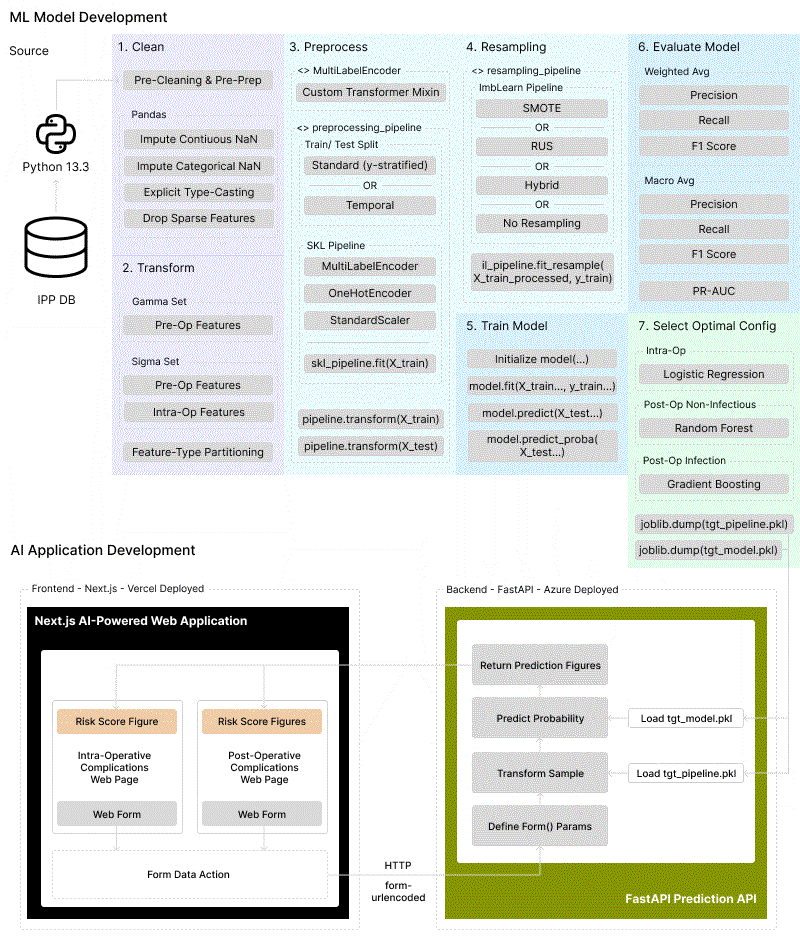 Figure 1. Workflow of Machine Learning and AI Application Development for the IPP Risk Calculator.
Back to 2026 Abstracts


