Back to 2026 Abstracts
Kidney Stone Growth Parameters Following Anti-Obesity Treatment with GLP-1 Receptor Agonists and Bariatric Surgery
Theodoros Karanikolas, BA1, Jonah Tripp, BA, MPH2, Hudson Jakubowicz, BA2, Valmic Patel, MD1, Jake Drobner, MD1, Dima Raskolnikov, MD1, Alexander Small, MD1.
1Montefiore Medical Center, Albert Einstein College of Medicine, Bronx, NY, USA, 2Albert Einstein College of Medicine, Bronx, NY, USA.
BACKGROUND: Glucagon-like peptide-1 receptor agonists (GLP-1 RAs) such as semaglutide have transformed metabolic disease and obesity management; however, their impact on nephrolithiasis—a known risk of obesity treatment with weight loss surgery (WLS)—remains poorly understood. We compared the impact of WLS and semaglutide on kidney stone parameters.
METHODS: We retrospectively identified patients diagnosed with nephrolithiasis (2017−2019) who subsequently underwent WLS (gastric sleeve or gastric bypass) or initiated semaglutide. Inclusion required computed tomography (CT)-based stone surveillance before and after intervention. Variables abstracted included demographics, body mass index (BMI), weight loss treatment data, stone intervention, and CT-based stone burden. Where multiple CT examinations were available, stone growth rates were compared using Wilcoxon rank-sum tests.
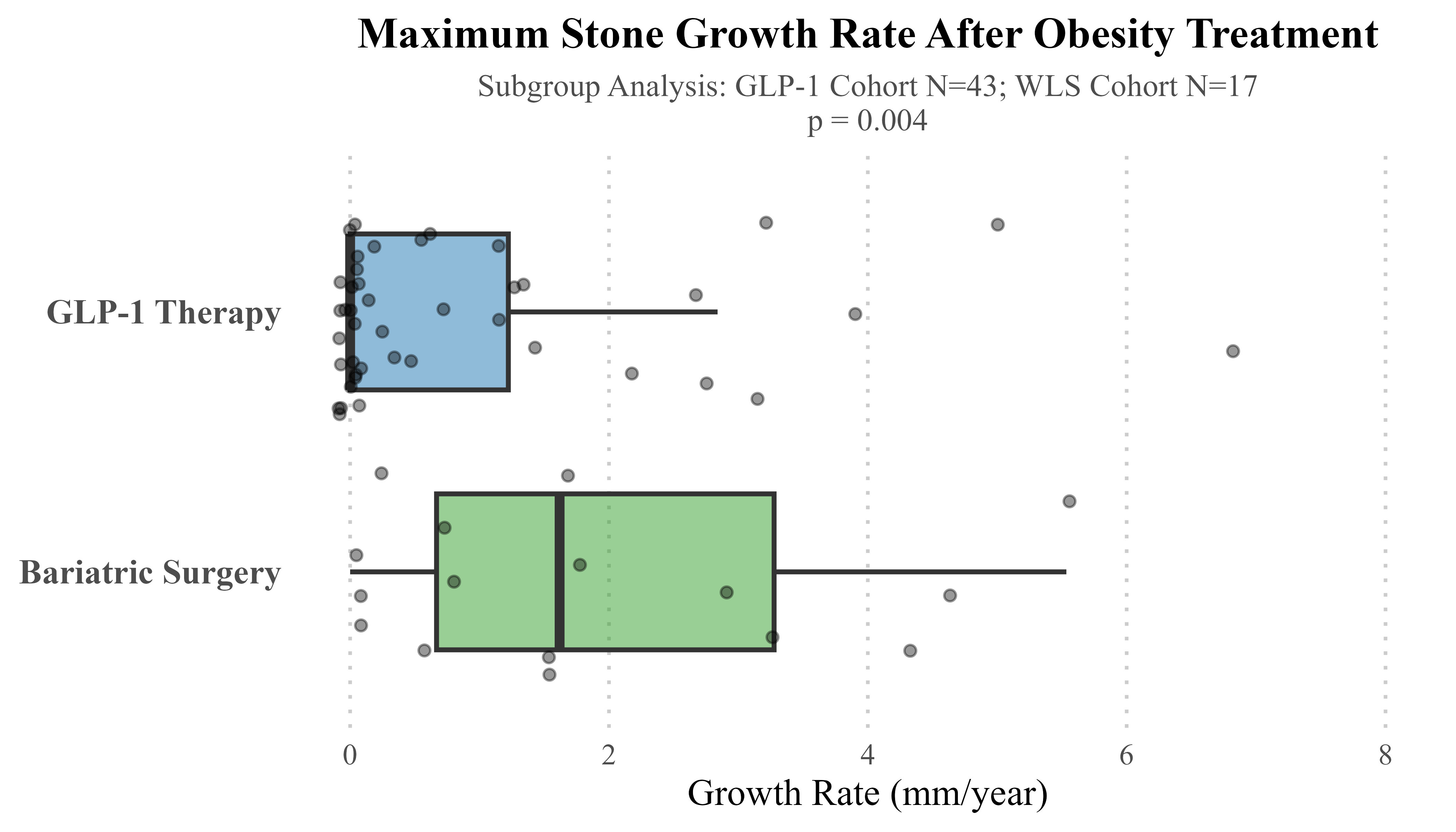
RESULTS: Among 160 patients, 117 (73%) received semaglutide and 43 (27%) underwent WLS. WLS patients were younger (median 48 years vs 61 years; p < 0.001), had higher baseline BMI (42.0 vs 32.0 kg/m²; p < 0.001), and experienced greater BMI reduction (−10.2 vs −2.2 kg/m²; p < 0.001) than semaglutide patients. Post-treatment, median maximum stone dimension (4 mm vs 2 mm), total stone burden (4 mm vs. 3 mm), and rates of surgical intervention for stones (26% vs 24%) were similar between the WLS and semaglutide treatment groups (p>0.5). Among 60 patients with ≥2 post-index CTs (43 semaglutide, 17 WLS), median maximum stone growth rate was lower with semaglutide (0.0 [IQR 0.0-1.2] mm/year) than WLS (1.6 [IQR 0.7-3.3] mm/year; p=0.004).
CONCLUSIONS: GLP-1 RA treatment with semaglutide was associated with slower stone growth when compared with WLS, suggesting a potential lithoprotective effect. These findings highlight a favorable renal stone profile for semaglutide relative to bariatric surgery in patients with recurrent nephrolithiasis.
Back to 2026 Abstracts


