Back to 2026 Abstracts
Multicenter Comparison of Stone Clearance with CVAC Aspiration Ureteroscope and Flexible and Navigable Ureteral Access Sheaths
Jackson Cabo, M.D.1, Stephen A. Harrington, M.D.2, Vernon M. Pais, M.D.2, Levi Bowers, M.D.3, Nicole Miller, M.D.3, Ryan Hsi, M.D.3, Runhan Ren, M.D.4, Ben Chew, M.D.4, Connor Forbes, M.D.4, Austin Chien, M.D.5, Jack Hannallah, M.D.5, David Tzou, M.D.5, Daniel Turin, B.A.6, Aaron Potretzke, M.D.6, Kevin Wymer, M.D.6, Garrett Ungerer, M.D.6, Kevin Koo, M.D.6, Christopher Ballantyne, M.D.1, Adam Ostergar, M.D.1, Mitchell Humphreys, M.D.1, Karen Stern, M.D.1.
1Mayo Clinic, Phoenix, AZ, USA, 2Dartmouth Health Medical Center, Lebanon, NH, USA, 3Vanderbilt University Medical Center, Nashville, TN, USA, 4University of British Columbia, Vancouver, BC, Canada, 5University of Arizona, Tuscon, AZ, USA, 6Mayo Clinic, Rochester, MN, USA.
BACKGROUND: The introduction of suction technology for ureteroscopic treatment of renal stones has substantially changed practice patterns. We aim to compare outcomes in patients undergoing ureteroscopy for renal stones using either Flexible and Navigable Ureteral Access Sheath (FANS) or the CVAC 2.0 system in a large, multicenter study.
METHODS: A retrospective analysis was completed on patients undergoing flexible ureteroscopy for renal stones at six institutions from March 2024-June 2025. Patient demographics, intraoperative data, volumetric and single-dimension stone clearance on CT, and complications were evaluated. Stone-free rates (SFR) using Endourological Society Guidelines were compared. Pearson correlation analysis was performed between pre-operative and post-operative stone volume.
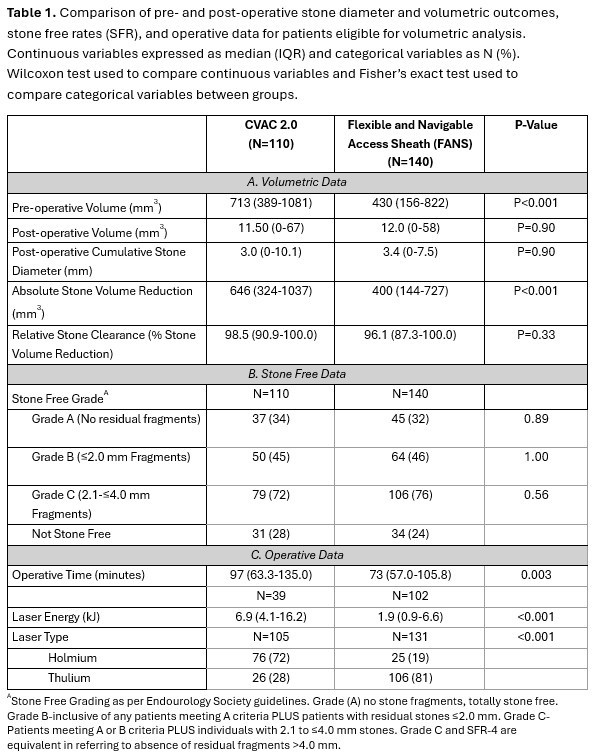
RESULTS: 504 cases (CVAC-280, FANS-224) were included; 250 cases eligible for volumetric analysis. Pre-operative stone volume was larger in the CVAC group versus FANS (713 mm
3 vs. 430 mm
3;P<0.001). Absolute stone clearance was greater with CVAC (646 mm
3 vs. 400 mm
3;P<0.001), while residual stone volume (RSV) (11.5 mm
3 vs. 12 mm
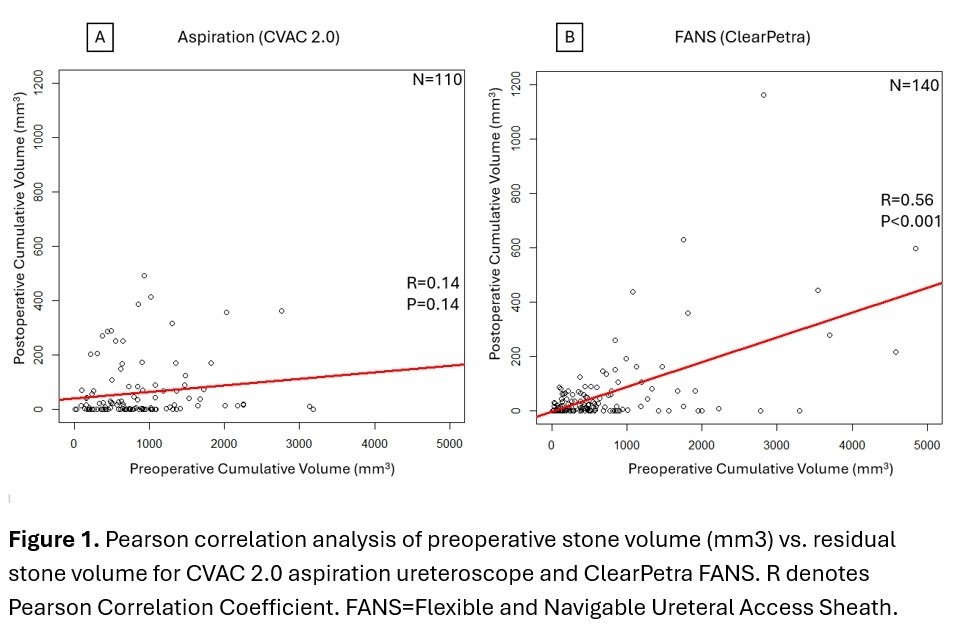
3;P=0.90) and absolute SFR (SFR Grade A, 34% vs. 32%;P=0.89) were similar. In individuals with >2 cm preoperative stone burden, relative stone clearance was greater with CVAC, though this was not statistically significant (97.1% vs. 94%;P=0.39). There was positive linear relationship between pre-operative and RSV for FANS (r=0.56;p<0.001), but not CVAC (r=0.14;P=0.14) (Figure 1).
CONCLUSIONS: In this multicenter study of FANS and CVAC, >95% stone clearance was observed in both groups. In contrast to FANS, RSV with CVAC did not increase significantly with increasing pre-operative stone volumes, suggesting a potential advantage with larger stone burdens.
Back to 2026 Abstracts


