Back to 2026 Abstracts
Genitourinary Events following Tri-modality-Therapy for Muscle invasive Bladder Cancer
Sarah J. Leick, MD1, Jillian M. Egan, MD2, Linda V. Nguyen, MD1, Xiu Liu, MS1, Matthew F. Wszolek, MD1, Richard J. Lee, MD, PhD1, Jason A. Efstathiou, MD, DPhil1, Adam S. Feldman, MD1.
1Massachusetts General Hospital, Boston, MA, USA, 2Albany Med Health System, Albany, NY, USA.
BACKGROUND:Tri-modality Therapy (TMT) has become a guideline supported treatment option for muscle invasive bladder cancer with comparable cancer-specific survival to radical cystectomy in appropriately selected patients. However, long term TMT-associated genitourinary morbidity remains incompletely characterized. Our study quantified genitourinary events following TMT as an objective assessment of quality of life.
METHODS:We performed a retrospective single-institution study, including all patients who underwent TMT following their diagnosis of muscle invasive bladder cancer from 2000-2017 at Massachusetts General Hospital. Data was collected through systematic chart review, assessing genitourinary events and their onset after TMT. The pre-specified endpoints were cystectomy or surgical diversion (ileal conduit), hematuria, non-surgical diversions (ureteral stents, nephrostomy tubes, indwelling urethral catheter) and bladder stone formation.
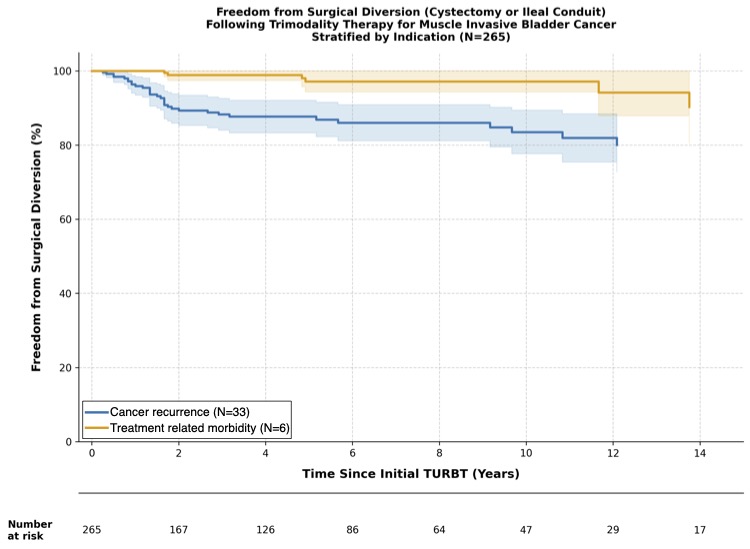
RESULTS:Our cohort contained 265 patients. Mean age was 68.4 years [±11.1] and median follow-up was 53 months [IQR 18-98]. 226 (85%) patients retained their native bladder at last follow-up. As shown in figure 1, 33 (12.5%) patients received a salvage cystectomy or palliative diversion for cancer recurrence. 6 (2.3%) patients required cystectomy or diversion for treatment-related morbidity, including radiation cystitis with bladder perforation (3), fistula (1) or severe bladder dysfunction (2). 27 (10.2%) patients experienced symptomatic radiation cystitis with significant hematuria following TMT, requiring medical evaluation and/or intervention. 26 (9.8%) patients developed hydronephrosis requiring ureteral stent or nephrostomy, of whom 15 (5.7%) were due to cancer recurrence and 10 (3.8%) were attributable to treatment-related morbidity. Incidental bladder stones were identified during follow-up in 25 (9.4%) patients.
CONCLUSIONS:In this large single-institution cohort, genitourinary morbidity after TMT is low and cystectomy attributable to treatment-related morbidity is rare. Our results further support TMT as a viable bladder-sparing strategy with an acceptable toxicity profile.
Back to 2026 Abstracts


